
Editorial review
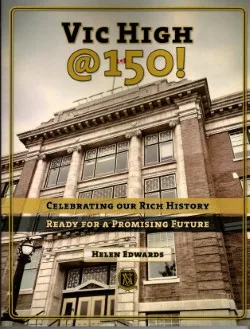
Vic High @ 150!
By Helen Edwards
Threaded with memorable photographs and anecdotes, Vic High @ 150! is a powerful homage to one of North America’s oldest public high schools.
Reviewed by CANREADS
Find your copy
How often do we stop to consider the history of the schools that shaped us?
Helen Edwards’s history of Victoria High in Vic High @ 150! centres North America’s favourite place to remember: high school. These formative years stay with us, yet we rarely consider the history of the institutions themselves. Edwards goes deep, exploring the relevance that a school, its history, and alumni can have on our city, county, and world. Threaded with memorable photographs and anecdotes, Vic High @ 150! is a powerful homage to one of North America’s oldest public high schools.
To many, high school is a collection of fond memories; to Edwards, Victoria High represents the fullness of community. The book unfolds in three parts, beginning with the fifty years following the school’s centennial celebrations. A shorter middle section documents the decisions and government involvement surrounding its renovation, while an extensive collection of alumni memories fills the latter half with personal recollections. Together, these sections offer several ways into the school’s past, from the practical challenges of maintaining its buildings to the attachments that endure long after graduation. Photographs provide another point of connection, lending faces and physical detail to the historical record.
The book’s most affecting passages reveal how closely the classroom and the wider world have always been connected. Throughout the first five chapters, Edwards recounts how the two World Wars affected the school community, with biographical tributes recording former students’ military service. The school’s memorial to alumni who died in war brings these losses into sharp focus. It is an eerie reminder that for a time, as Edwards notes, someone could go from high school in Canada to a battlefield in Europe. Because of the sacrifices of these young men and women, Canadian students must no longer endure that uncertainty. Here, the school’s history acquires an emotional weight that reaches beyond local interest, and Vic High @ 150! becomes a moving high school history lesson you’ll want to turn up for.
The breadth of material is both an asset and a structural challenge. Edwards gathers numerous interesting facts, but the movement between institutional history, brief biographical tributes, and personal recollections can feel diffuse. A brief recap of the school’s first century would help orient readers unfamiliar with its earlier history before the account picks up at the centennial. The alumni section would also benefit from clearer thematic grouping to help individual memories contribute to a larger picture, while exploring a few lives in greater depth could give readers a stronger sense of the school’s influence beyond its grounds.
Still, Vic High @ 150! preserves a distinctive part of Canadian history that many readers may not know. For alumni, community members, and those drawn to British Columbia’s local history, its value lies in bringing together public milestones and personal memories that might otherwise disappear. Under Edwards’s pen, one school’s story becomes a tribute to the lasting influence of high school. Vic High @ 150! gives Victoria High’s past a lasting place on the page—and its community a reason to remember.
—CANREADS BOOK REVIEW