
Editorial review
Brave Cuts
By Dr. Sanjiv K. Gandhi
A profoundly human story of grief, purpose, and the fragile lives that remain with a physician long after an operation ends.
Reviewed by CANREADS
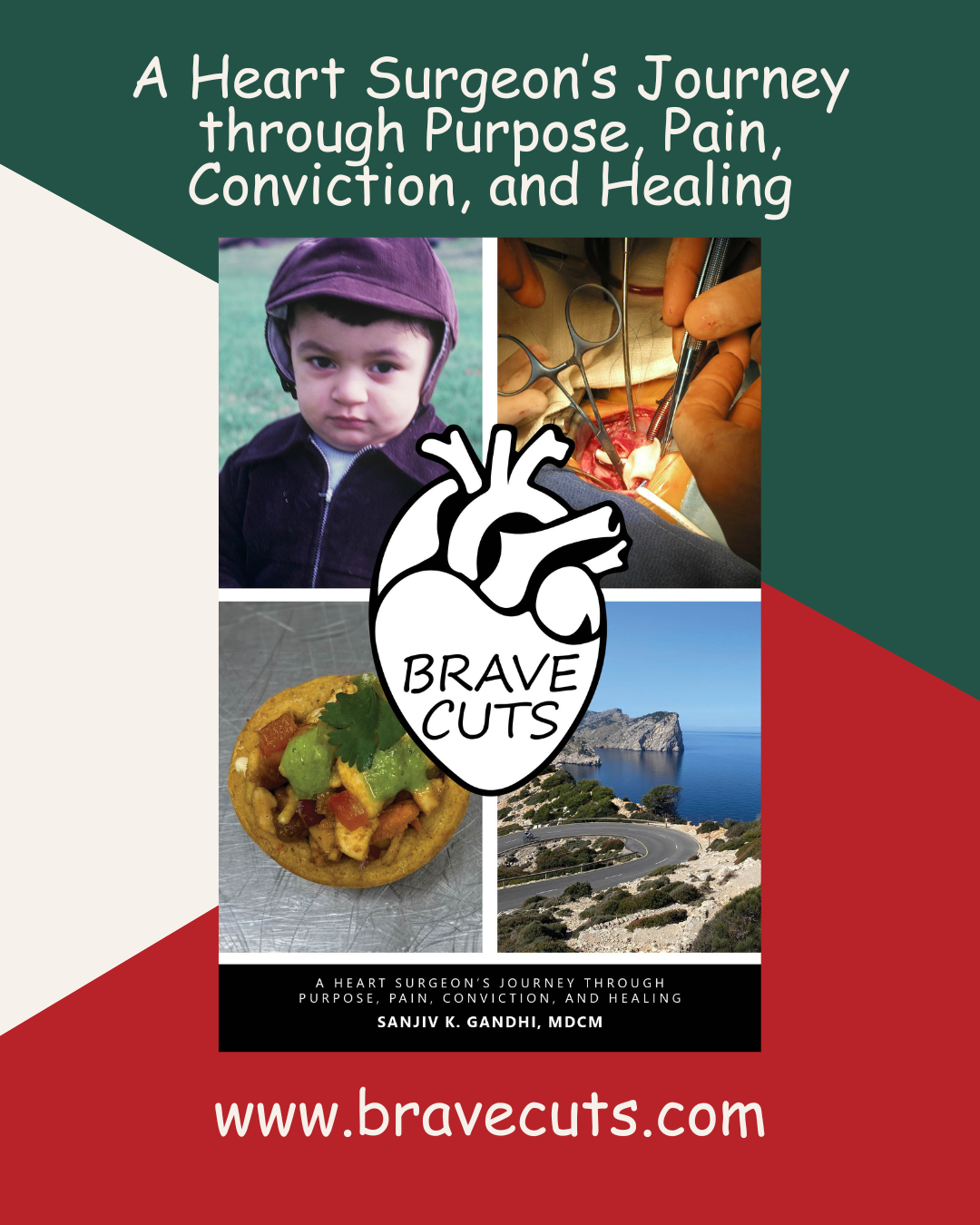
A boy loses his mother on a September night in 1987, and spends the next four decades learning to mend broken hearts.
Dr. Sanjiv K. Gandhi’s memoir Brave Cuts is written with all the urgency and candor of . . . well, an operating room. Structured around the stages of surgery—Pre-op, Intra-op, Post-op, and Recovery—the memoir follows a teenager shattered by the death of his mother at the hands of a drunk driver, a son shaped by his father’s medical discipline, and a surgeon forever changed by the patients entrusted to his care. Beneath its clinical framework beats a profoundly human story of grief, purpose, and the fragile lives that remain with a physician long after an operation ends.
Between chapters chronicling his residency and later surgical practice, Dr. Gandhi folds in family recipes like keepsakes. Eulogies and commencement speeches, dug out of decades-old boxes, are preserved in a moving story that dares to go beyond the scope of a career narrative. The narrative occasionally wanders outside medicine, yet it continually returns to one central truth: every human heart is delicate, sacred, and worth protecting.
Gandhi makes complex medical material accessible without sacrificing precision. He writes about surgery with clinical clarity and about himself with devastating honesty. His plainspoken prose resists self-mythologizing, allowing uncertainty, regret, and contradiction to remain visible. This willingness to sit with his own conflicts infuses the book with emotional honesty and depth. He is careful to ensure that despite the technical jargon of surgery, readers always feel connected to the telling.
The book’s considerable breadth occasionally strains its focus. Political commentary can sit awkwardly beside the intimate medical chapters, while extended discussions of hospital politics and public health slow the emotional momentum. These subjects are important, but their more didactic treatment sometimes draws attention away from the personal material Gandhi has constructed with such care. Readers captivated by the memoir’s tender core may find their attention tested during these passages. Even so, the book’s emotional pulse remains steady: the mother Gandhi lost, the patients he could not save, and the lives he helped preserve.
Touching, informative, and unflinchingly sincere, Brave Cuts examines grief through the life of a man who transformed loss into a lifetime of care. The memoir will resonate with readers who search for family-centred memoirs and fans of medical dramas that love tension built between clinical settings and personal stakes.
By its final pages, Brave Cuts reveals the full meaning behind Gandhi’s vocation. The boy who could not save his mother grew into a surgeon devoted to giving other children more time with theirs. Written with a surgeon’s precision and a son’s enduring love, Brave Cuts is a beautiful exploration of how we repair the hearts placed in our care—and how, in doing so, we begin to heal our own.
—CANREADS BOOK REVIEW