
Editorial review
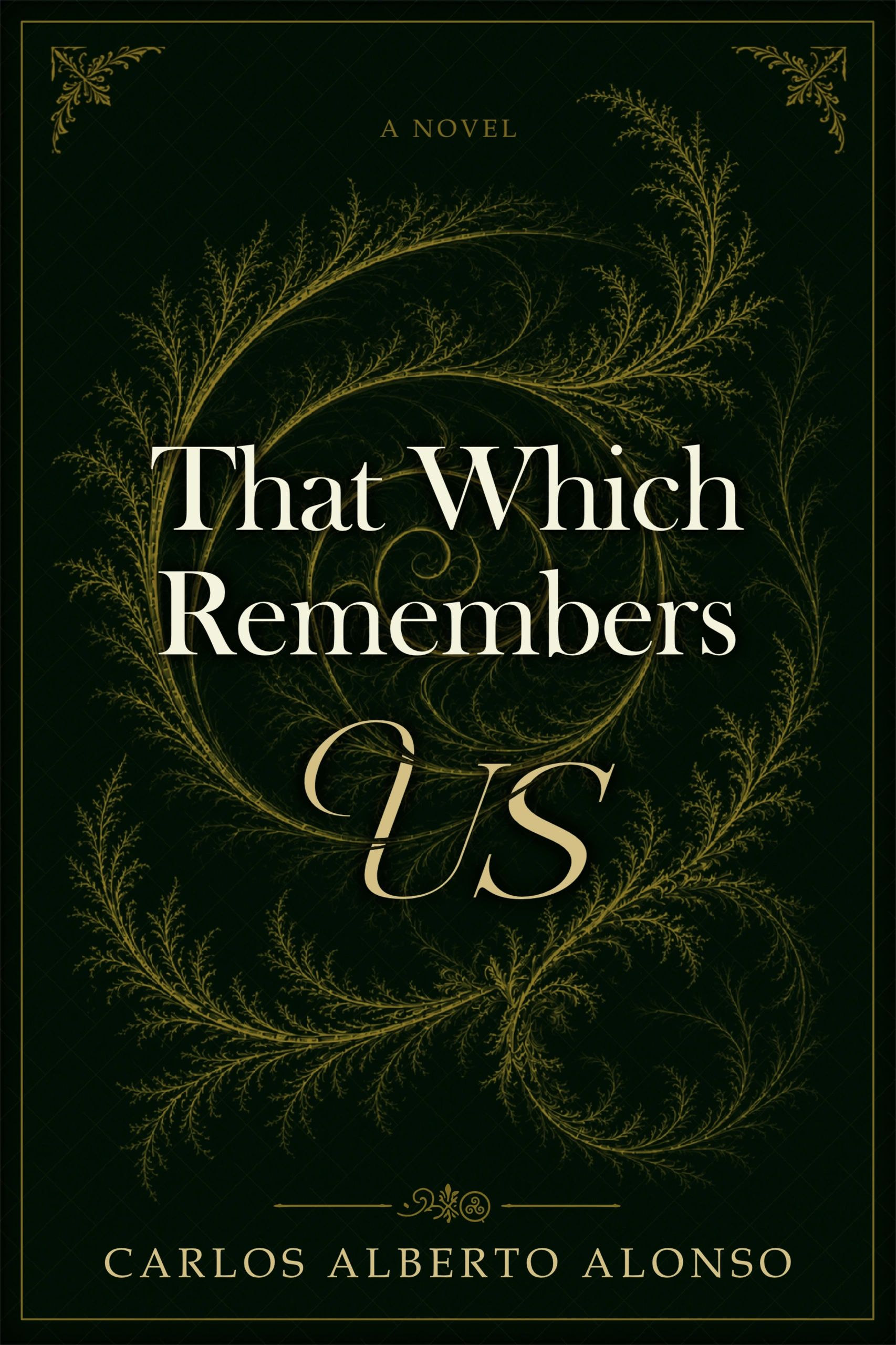
That Which Remembers Us
By Carlos Alberto Alonso
What do we inherit when the memories of those who came before us begin to disappear?
Reviewed by CANREADS
What do we inherit when the memories of those who came before us begin to disappear?
In That Which Remembers Us, Carlos Alberto Alonso crafts a haunting speculative world where life itself is threatened by the erasure of memory. Exploring the intricate entanglement between humanity and technology, Alonso considers the ways power can shape, manipulate, and corrupt both. In a world built on forgetting, memory becomes its own form of resistance.
The opening pages paint a vigil for Lucas Vireaux, whose granddaughter Patricia Ferme is more stranger than family. After his disappearance, Patricia inherits his house and, while stumbling through childhood memories, discovers a thick stack of papers bound in leather and marked with the unfamiliar inscription “For Vala.” Unbeknownst to her, Lucas’s legacy is already sending ripples toward a looming threat. What begins as a story of grief and a trip down memory lane quickly unfurls into chaos, with friends and foes tugging Patricia in opposing directions.
A tale woven with drama, history, perspective, and rhythm, That Which Remembers Us challenges readers to consider the value of memory in a future where its loss draws near. Layered with every sense, Alonso creates an evocative reading experience that feels larger than words on a page. Each setting is carved out in a recognizable yet intriguing world shaped by change, where the future still resembles the past. The future may look unfamiliar, but its ghosts know all the old songs. Forgotten rituals, stories, and melodies become traces of a collective awareness on the brink of extinction.
With a style uniquely suited to the story on its shoulders, Alonso’s approach may take some time to settle into. Once readers adjust, however, the novel becomes a clever journey of orchestrated dialogue, perspective, and rhythm. The pacing is occasionally inconsistent, particularly when shifts to Bybrook Labs interrupt the narrative flow and require readers to readjust. Alonso’s lyrical style can also create moments of vagueness, while some of the novel’s intriguing ideas surrounding sound and memory are explored less consistently than others. Even so, an underlying urgency carries the narrative as glimpses of the past become increasingly vital to the present.
Alonso demonstrates a profound understanding of grief, embracing a sombre tone that naturally meanders into the softer, comforting colours of reminiscence. Patricia occupies a liminal space where past and present brush against each other, mingling through chants, stories, and rituals. But beyond her character, Alonso understands that grief has no single memory and no single shape. Each character mourns differently, and through these characters, That Which Remembers Us leaves an emotional impression that stays in the contours of readers’ hearts.
Readers who enjoyed the mixture of music and humanity in Honeybees and Distant Thunder by Riku Onda will find much to love here. With an intimate cast of characters and a multisensory experience, That Which Remembers Us probes what we are willing to sacrifice to survive. To remember is to carry grief, but in Alonso’s world, forgetting may cost far more. Celebrating and mourning worlds both preserved and erased, Alonso gives weight to the traces people leave behind.
—CANREADS BOOK REVIEW
Published by ALONSO Books